Showing posts with label webmaster. Show all posts

Wednesday, April 6, 2016

Google site ownership verification per DNS


Many (or perhaps all?) seo / webmasters all have their sites verified in Google search console (and others). There are currently several options to verify ownership of a site, usually a domain or a subdomain. Many people use a file that's uploaded into the root folder of their site or a meta tag on the homepage.

If you have access to a DNS, adding a TXT entry to the DNS is a great option. We actually use several methods to verify the same domains, for example the meta tag + DNS, or verification file + DNS to add some extra protection in case one breaks.

This is the official (new) guideline from Google, but it is also explained in GSC. There's a second page with the details for the 4 different DNS entry variations that can be used - up to now I only had seen the first two.
One adds just a TXT entry with some copy in it, and the copy starts with "google-site-verification=' and then adds a specific entry per domain.

We have lots of domains, and a dedicated DNS team, so I needed to test if they implemented correctly - and as usual a quick script.
Script to test DNS TXT entry for google verification is below, and the output works - as shown with domains with this entry, and below without.


Done with a few domains where I don't have the DNS entry:


while read domain; do
dig -t TXT $domain | grep "TXT" | grep "google-site-verification"

done < $1

Tuesday, February 16, 2016

site search box in SERP


Many of us site managers and tech Seo will have thought about using the sitesearch link box in Google results. When Google displays expanded results with sub-results, they offer to integrate a sitesearch box. Posts on this are rare, and have little info on the impact of these. What I have seen so far indicates that there's no significant impact on natural search traffic. Information about on site conversion (closer match should increase on-site conversion) is not published to my knowledge, and would be hard to separate out from the overall search.

There are three options to deal with this Google offer:
1. ignore, do nothing
2. block the searchbox actively
3. integrate schema into the homepage of the site to 'invite' Google to add the box.

Which route to go? A first step, as often, is to look at how common it is to use one of these options. Working on one of the largest websites, I compare here with the top 10,000 sites by traffic as estimated by Alexa (top million sites report).

Now showing:

  1. how many block, use schema, do nothing,
  2. average rank of blocked sites compared to sites with schema
  3. what do the top sites do (surprise)
  4. top sites blocked by rank
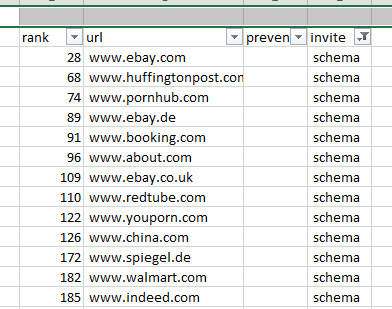
  5. top sites with schema by rank 
  6. bash script to test


1. How many block, use schema, do nothing


2. Average rank of blocked sites compared to sites with schema


3. What do the top sites do (surprise)

4. Top sites blocked by rank

5. Top sites with schema by rank 

6. Bash script to test


while read -r line; do
if [[ $line != www* ]]; then
line="www.${line}"
fi
output=$(curl -s "${line}" )
nobox=$(echo "$output" | grep "nosite")
boxschema=$( echo "$output" | grep "SearchAction")

if [[ $nobox != "" ]] ; then
nobox="blocked"
fi

if [[ $boxschema != "" ]] ; then
boxschema="schema"
fi

echo -e "$line \t $nobox \t $boxschema" | tee -a nobox-or-box.txt


done < $1


Bookmark and Share